There's no escaping it any longer: after decades of hemming and hawing, Koa's specifier system is just too damn complicated.
One might feasibly inquire what articles are doing in a putative IAL in the first place, and I've made a number of valiant attempts over the years (2010 and 2012, for example) to justify their existence by rigorously defining their use. Nonetheless, some inconvenient facts have been gently tapping on my shoulder recently, such as:
* Though theoretically beautifully defined, the system is so complex that the creator herself is often unsure of the best specifier choice in practice
* Specifier choice criteria seem to be much more detailed in pre-verbal (i.e. subject) position than post-verbally
* Following what you might call adjunct particles (ci he la lo me mo ne no o pe) there seems to be only a binary distinction -- definite vs indefinite -- which has never caused a problem
Indeed, going way, way back to basics, I have to confess that the most critical function of Koa specifiers is not in fact to elegantly plot fine distinctions on the axes of deixis, referentiality and discourse relevance, but probably just to help parse those predicates in the speech stream. As such, when preceded by one of those aforementioned adjunct particles, the primary work is already done and we can content ourselves with the pragmatic considerations that really matter: apparently only whether the NP in question is definite. Let's see, then, if we can reduce the system to a set of much simpler principles.
DEFINITE NPs are marked with ka when singular or optionally u when plural, unless:
* The NP requires being pointed at, whether physically or metaphorically, in order to be identifiable -- use ti/to "this/that"
* The NP is inalienably possessed by a pronominal referent -- use the relevant personal pronoun
* The NP is a name -- use le
INDEFINITE NPs are unmarked when preceded by another particle, or marked with a otherwise.
If you've been following the plot closely so far, you may have noticed that hu and po are conspicuously absent from the above taxonomy. I would in fact like to advance the theory that these have never been specifiers at all, but were mistaken as such because of their tendency to appear most frequently before unmarked NPs!
Let's start with the basic supposition that hu and po are in fact quantifiers, not specifiers: specifically ∃ and ∀, respectively. They can quantify indefinite NPs -- in which case there would be no article -- or definite ones, in which case they would be marked as described above. Examples of use, with both a logical and vernacular gloss:
po lulu i sihi
ALL flower VP plant
"for all flowers, it is the case that they are plants"
"(all) flowers are plants"
po ka lulu i puna
ALL DEF flower VP red
"for all of the flowers in a predefined set, it is the case that they are red"
"all the flowers are red"
hu lulu i puna
EXIST flower VP red
"for at least one flower, it is the case that it is red"
"a/some flowers exist such that they are red"
"some flowers are red," "there are red flowers"
hu ka lulu i puna
EXIST DEF flower VP red
"for one or more of a predefined set of flowers, it is the case that they are red"
"some of the flowers are red"
That seems clear and simple enough, but probably the thorniest area in the treatment of indefinite NPs has been in the choice between a and hu. For the last several years it's seemed that in practice the former is used for instantiated nouns -- real, specific things -- not yet raised to the discourse stage, whereas hu marked the NP as non-referential. Thus, heretofore:
1) ni mene la ko kou a tusi
1SG go DAT ABS buy INDEF book
"I went to buy a (certain) book"
2) ni mene la ko kou hu tusi
1SG go DAT ABS buy EXIST book
"for some book, it is the case that I went to buy it"
"I went to buy a (theoretical, not yet identified) book"
...but this is clearly far, far too fine a distinction to actually prescribe. Perhaps less elegant but more actually produceable by humans with competing resource demands beyond this single utterance:
1) ni mene la ko kou a tusi mao
1SG go DAT ABS buy INDEF book certain
"I went to buy a (certain) book"
2) ni mene la ko kou tusi
1SG go DAT ABS buy book
"I went to buy books, I went book-buying"
In fact ni mene la ko kou a tusi could potentially be interpreted in either sense according to context, and I think that's the important thing for me to accept here: that allowing context to play a role is not discarding all elegance or sophistication in this language.
Another place that things get confusing is around existential statements. What's the difference between these?
1) a lulu i ne ka masa
INDEF flower VP LOC DEF table
"a flower is on the table"
2) hu lulu i ne ka masa
EXIST flower VP LOC DEF table
"for at least one flower, it is the case that it is on the table"
"there's a flower on the table"
Semantically nothing at all, I think, but pragmatically these will have a different thrust. The purpose of (1) seems to be to communicate contextual information, whereas (2) is more concerned with the truth value of the proposition. If we really want to talk about existence and not truth value, I realized recently, we also have this option which is likewise vastly more human:
i me lulu ne ka masa
VP COM flower LOC DEF table
"there's a flower on the table"
or even
ka masa i me lulu (ne ta)
DEF table VP COM flower LOC 3SG
"the table's got a flower (on it)"
Hu is pretty straightforward for "some" in at least the quantifier sense of the English word, but note that there is a more periphrastic possibility as well:
hu lulu i puna
EXIST flower VP red
"some flowers are red" or "there are red flowers"
nai pi lulu i puna
some QUANT flower VP red
"some flowers are red"
So somehow or other that was actually pretty...easy? I'm almost a little nervous about it after all these years of fretting. I'll get back to you after I've tried it out in everyday usage.
Coming up next: if that's all clear now, maybe I can finally tackle how to say "something" and "nothing," a problem that has vexed me as long as I can remember -- this all came up right at this moment because I'm working on a bidirectional dictionary for my girls, and I couldn't figure out what to list as the generic translations!
Monday, November 28, 2022
What's in a specifier?

Friday, September 16, 2022
Happy birthday to Koa!
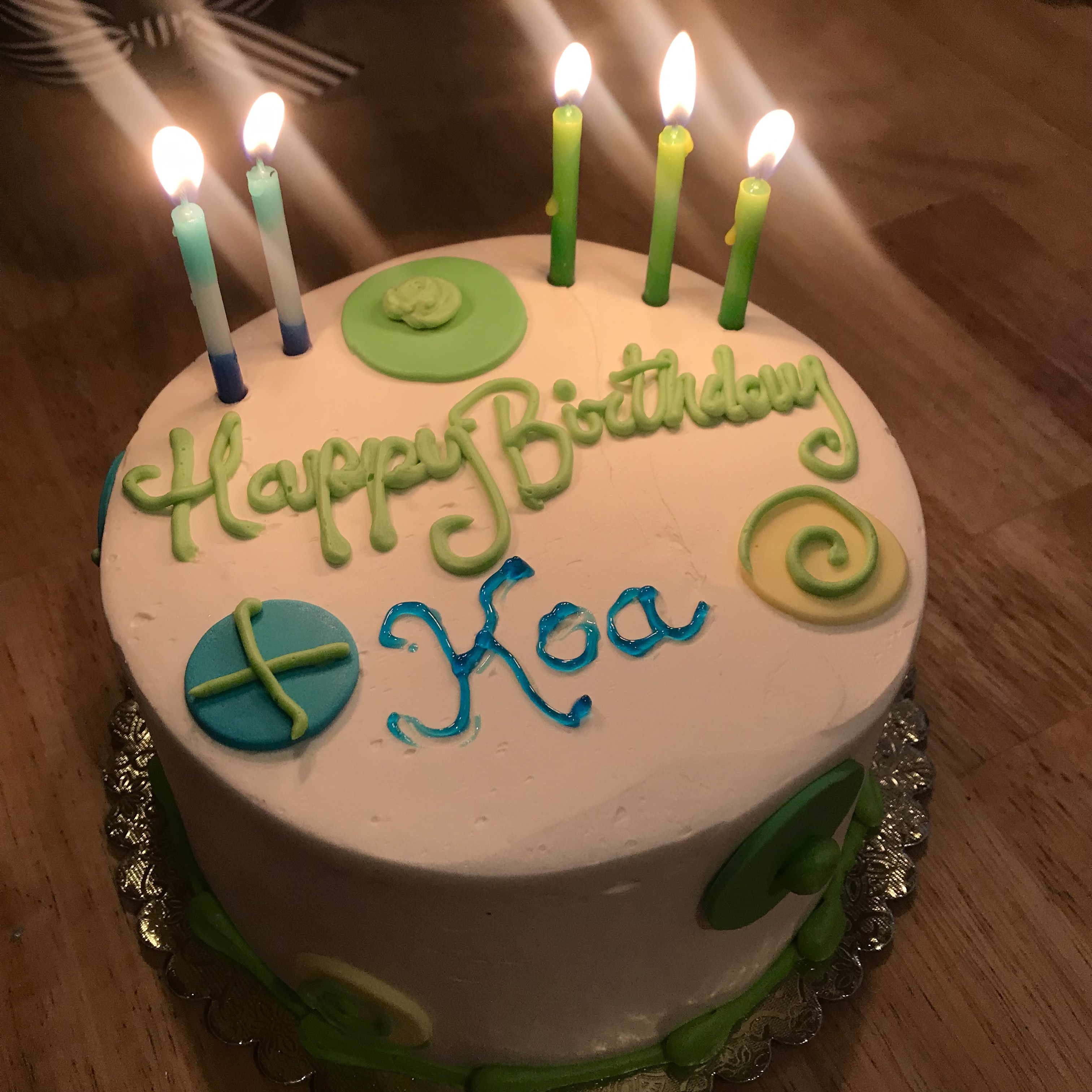
This week on September 13th we had the world's first ever Koa Day celebration, including not one but two cakes: one improvised by Callie and me, and the other rather more artfully facilitated by Olga.

ALSO, and perhaps most importantly, there is now a Koa birthday song! It's just a direct translation of the American song, but still. Unsurprisingly we've got an extra syllable at the start of each line which means we have to start with an 8th note triplet, but it still works:
Pai Náute Iolo
Pai náute iolo la se
Pai náute iolo, X mila
Pai náute iolo la se
The syntax here is so straightforward I think we can dispense with the interlinear, but I did want to say something about náute. Since nau means "give birth to, bear," the most accurate translation of "birth" from the point of view of the offspring would in fact be panáute: the occasion of being born, not the occasion of giving birth (way more on that here). In terms of actual usage, though, it's a needlessly granular distinction to have to make...and would throw off the meter even more, so clearly aesthetics are going to have win out here.
It does raise the question, though, of whether it's ever actually a helpful or meaningful distinction -- súsote "kisses given" vs pasúsote "kisses received," -- since all the arguments are represented in the instance being described regardless of which way way around you turn it. My instinct is maybe not, at least in a real human language. Not that it should be forbidden where it happens to add meaning, but also not prescribed.
Friday, April 8, 2022
Verum focus
Though Describing Morphosyntax termed this "truth value focus," quite a lot of research last month informed me that the best technical term these days is "verum focus," or just "verum" as some people are very passionately willing to argue. I was gearing up for some major construction when I realized that Koa actually already has a built-in way to do this! Let's first look at a pragmatically neutral clause in AFF/NEG/INT forms:
ni te puhu le níkili
1SG ABIL speak NAME English
"I speak English"
ni na te puhu le níkili
1SG NEG ABIL speak NAME English
"I don't speak English"
ai se te puhu le níkili?
QU 2SG ABIL speak NAME English
"Do you speak English?"
The simplest way of focusing on verum is via the particle ia, initially conceived as a firsthand experience or vouched-for evidential but now clearly functioning as as a veridical marker. It shifts the primary purpose of the utterance from the semantics of the constituents to a confirmation by the speaker of the utterance's truth value. As such one would expect that the clause to which it's attached would not contain any new information, since the focus, so to speak, is on verum in the context of a discourse stage with existing players; it would be anomalous if used without that existing context, or would at least cause the listener to infer that there was some existing context of which they were unaware. With our sample clauses from above, then:
ni ia te puhu le níkili
1SG VIR ABIL speak NAME English
"I DO speak English"
ni ia na te puhu le níkili
1SG VIR NEG ABIL speak NAME English
"I DON'T speak English"
ai se ia te puhu le níkili?
QU 2SG VIR ABIL speak NAME English
"DO you speak English?"
A note on accentuation: in AFF and INT contexts the main stress is on the ia above: ni iá te puhu... In NEG contexts, though, the stress in ia na is on na, and in fact they may be written together and accented to make this plain: ni ianá te puhu...
We can also get at this concept periphrastically with eso "real, actual, so" and a dependent clause:
eso ko ni te puhu le níkili
real COMP 1SG ABIL speak NAME English
"it is the case that I speak English"
na eso ko ni te puhu le níkili
NEG real COMP 1SG ABIL speak NAME English
"it is not the case that I speak English"
ai eso ko se te puhu le níkili?
QU real COMP 2SG ABIL speak NAME English
"is it the case that you speak English?"
These are pragmatically neutral again, though, without any particular focus. We can ratchet things up or add focus in a few different ways depending on how heavy-handed we want to get (translations here are kind of stilted -- real idiomatic English would of course use a variety of words and also intonation to get at the meaning: "no, look, I told you, I DO speak English," etc.):
eso sa ko ni te puhu le níkili
real FOC COMP 1SG ABIL speak NAME English
"the thing that's the case is that I speak English"
ia eso ko ni te puhu le níkili
VIR real COMP 1SG ABIL speak NAME English
"it IS the case that I speak English"
ia eso sa ko ni te puhu le níkili
VIR real FOC COMP 1SG ABIL speak NAME English
"the thing that IS the case is that I speak English"
Eso can also be used serially to mean "really/actually X," which introduces an interesting distinction we can make here.
ai se ia loha ni?
QU SG VIR love 1SG
"DO you love me?"
ai se loha ni i eso?
QU 2SG love 1SG VP real
"do you really love me?"
The translations might communicate what's going on to a native English speaker, but context is really critical in explaining the difference. In the first question with ai, the speaker has significant doubt as to whether the proposition is true, probably even predicting a negative answer. There's a sense of "tell me the truth, I need to know, I can take it." In the second sentence with eso, the speaker either thinks or hopes that the proposition is or may be true, and is seeking confirmation or reassurance.
It's interesting that the syntactic structure for verum focus is entirely different from that of constituent focus, but I think that's okay given that Gutzmann et al. claim that verum focus isn't really focus anyway; it seems like many languages have different structures for these kinds of emphasis.
Monday, April 4, 2022
Topics in Koa as a Second Language
My seven-year-old daughter Eleanor seems to be a born linguist -- a phonetician in particular -- and it's been fascinating and heartwarming in a way I definitely never expected to experience as she's gotten increasingly interested in Koa and started making an effort to speak it with me over the past six months.
For some reason bedtime tends to be when Koa drifts into our conversations, and it's impossible to describe the emotions when this little daughter of mine says unprompted -- as she often does now -- Ivo koa, mama. Ni loha se! "Goodnight, mama. I love you!" Recently she started counting our goodnight kisses and hugs: ena, lua, tatu, nei...
Today Eleanor took in the fact that Koa adjectives come after their nouns instead of before, and after a moment of amused delight, seemingly accepted and integrated it as she started to use that syntax effortlessly (anu kuma "hot water"). Last night she struggled for a moment with Koa's distinction between singular and plural "you," but again mastered it seemingly without effort. I've never been in a language class with kids this young before, and though with a lifetime of linguistics background I know about ease of learning at a younger age in theory, I've never seen this myself and it's just astonishing.
What's most salient to me, though, is what I'm learning about my own language's phonology through my daughter's ear. Eleanor has always been unusually perceptive about phonetics both in hearing and production (I remember her at 3 explaining the difference between Spanish and English no in a way that would have fit right in in an undergraduate linguistics class) and in her Koa I've discovered the following so far:
* Koa stops are unaspirated
* /o/ is closer than I might have expected, as she's occasionally confusing it with /u/
* My /l/ apparently sometimes approaches some kind of alveolar flap! This isn't necessarily surprising in theory given that /l/ is Koa's only liquid, but I certainly never did this intentionally.
I'm really hoping Eleanor might be able to help me figure out what's going on with /h/, actually, which I've been noticing some instability with lately. Depending on the day, it seems like one of three scenarios is happening: (1) that the onset of voicing in a /hV/ sequence is delayed potentially throughout the duration of the vowel, to the point that hake "search" can come out sounding like [ḁke] or even [ḁʰke]; or (2) that the onset of voicing occurs early, voicing the onset as in [ɦake]; or (3) sort of a combination of the two, where the /h/ is colored into breathy voice which then spreads through the vowel à la Gujarati: [a̤ke]. I'm very curious to discover what's apparently already occurred in the "natural" development of this language!
Possibly even more thrilling, Eleanor -- who already loves to "invent" fairy and animal languages, speaking them in fluent and phonologically coherent gibberish -- helped me create her first word today! She wanted to say "safety" but I didn't have a "safe" root yet, so she suggested lapa and I entered it into the books then and there. She continues to seem genuinely excited about the opportunity to contribute to the creation of this language, and I'm equally excited to suddenly have such an enthusiastic partner in what has until now been an entirely solo pursuit. I just could never have imagined that my daughter and I might find ourselves here.
Incidentally, "Koa as a Second Language" would seem to translate as le Koa mo Cimi Lúasi (KCL), should there ever be a need to refer to this important subject more efficiently.
Saturday, December 18, 2021
More about valence decrease and related phenomena
Object Deletion
The simplest way of reducing valence, if you want to call it that, is by deleting the object:
u sótama i tuho ka lina
DEF.PL soldier VP IMPF destroy DEF city
"the soldiers destroyed the city"
u sótama i ma tuho Ø
DEF.PL soldier VP IMPF destroy Ø
"the soldiers were destroying [things]"
Valence in Koa is pretty free compared to English. You've got a verb, and the subject position is required (unless it was previously stated or can be assumed, like i kuma he tana "it's hot today"), but beyond that you can kind of free-form the participants in the way you choose and anything omitted either (1) becomes indefinite or (2) is recovered anaphorically. This latter reading could therefore yield "the soldiers were destroying it" as an alternative interpretation to the previous sentence, if "it" were some referent already established in discourse.
It turns out that at some point we earmarked -pa as a suffix to indicate an indefinite object, which means we could resolve the ambiguity, if necessary, by saying
u sótama i ma túhopa
DEF.PL soldier VP IMPF destroy-INDEF
"the soldiers were destroying things, the soldiers were going around destroying"
That's clear enough, but it's not 100% obvious what that pa actually is...is it some kind of pronoun? I thought so at one point. Or is it more derivational, like "do X here and there/haphazardly/with undefined results?" These days I think hi can actually fulfill the role I'd envisioned for pa back then (see below) so I'll leave it as a suffix for the moment with no further pretensions toward independent status.
Reflexives
I was surprised to discover last night that I thought I already understood this once upon a time, but I'm not at all satisfied with a lot of those conclusions, and I'll start from scratch here.
The most neutral way of indicating that a verb's object is identical with its subject is via the particle hi. This is genuine valence reduction in that the verb's object slot for the repeated participant disappears when this particle is used.
ni hi loha
1SG REFL love
"I love myself"
ni hi ana ti kánute
1SG REFL give this injury
"I gave myself this injury"
Note that ditransitive verbs can become reflexive with respect to either the direct or indirect object.
In a somewhat more marked way, the valence of the verb can be left alone but a reflexive construction used for the object:
ni loha niími
1SG love 1SG-self
"I love myself"
ni ana ti kánute la niími
1SG give this injury DAT 1SG-self
"I gave this injury to myself"
There's an added sense of contrast or emphasis here, so depending on the context this structure might tend to show up with focalization as well. Combining the two strategies is also possible with a serial verb, with even greater centering of the reflexiveness:
ni hi loha i imi
1SG REFL love VP self
"I love myself"
Semantic reflexiveness can come in via an incorporated object as well:
ni loha imi
1SG love self
"I love myself," "I self-love"
This gives a slightly different meaning, though: we're implying that self-love is a thing, and that the speaker practices it.
There's one final undecided point, though, of just how pronominal hi is allowed to get within VP arguments: in other words, can/should we say this instead for "I love myself"?
?ni loha hiími
1SG love REFL-self
"I love myself"
On purely aesthetic grounds I do greatly prefer it when languages have a reflexive pronoun (e.g. Polish golę się, lit. "I shave oneself" vs Spanish me afeito, lit. "I shave me") but this does potentially introduce a host of complications. Which of these is "I love my cat?"
ni loha ka sene ni
1SG love DEF cat 1SG
ni loha ka sene hi
1SG love DEF cat REFL
At the moment the sentence with hi is feeling pretty weird to me so I think we can nix that unless some emergent circumstances demand it in the future.
Reciprocals
In reflexive verbs the totality of the action applies to all subjects individually. Reciprocals, in which the action travels from each of a plurality of subjects to each other subject, are formally very similar. The least marked structure is actually the same as for reflexives, and context disambiguates 95% of the time:
nu hi loha
1PL REFL love
"we love each other" OR "we love ourselves"
The possibilities for overt disambiguation exactly parallel those for reflexives with the same minor differences in sense, using the word kahi "reciprocal":
nu loha nukahi
1PL love 1PL-reciprocal
"we love each other," lit. "we love our reciprocal ones"
nu loha kahi
1PL love reciprocal
"idem," lit. "we love reciprocally"
nu hi loha i kahi
1PL REFL love VP reciprocal
"we love each other [reciprocally]"
Object Incorporation
When a transitive verb has a general, non-referential object, the most neutral structure is to incorporate it: in Koa terms, to omit the article so that it modifies the verb rather than standing on its own as an independent object. This reduces the verb's valence by one slot and is explored pretty thoroughly (with surprisingly few differences from modern usage) in this post from 2011, so I'll let that explanation stand in the interest of brevity. This gives us clauses like
u sótama i ma tuho lina
DEF.PL soldier VP IMPF destroy city
"the soldiers were destroying cities," "the soldiers were engaging in city-wrecking"
Passive/Middle Voice and Argument Shifts
Though traditionally labeled "passive," the particle pa affects argument structure in a manner that's pretty unlike the passive voice in IE languages. pa "promotes" a verbal object to subject position, but it also optionally "demotes" the subject to postverbal -- i.e. object -- position. The structure thereby created allows the agent/experiencer can be elided in a way it cannot in preverbal position, and valence is not technically decreased (depending on how you want to define object deletion).
As such, pa verbs are able to say something about their patient without inferring anything at all about their agent or experiencer, or even implying their existence. In this way it's more similar to a middle voice:
to puku i pa tino mo vake
that costume VP PASS take.off ADV difficult
"that costume 'takes off' with difficulty," "that costume is hard to take off"
A more passive reading is possible as well:
ka lina i pa tuho he to kesa
DEF city VP PASS destroy TIME that summer
"the city was destroyed that summer"
The wild difference from IE passives and middles, and one that I would consider the most Loglanesque operation in the whole of Koa if it hadn't been rescued by Bantu, is that there is still an argument slot for the notional subject after the verb:
ka lina i pa tuho u sótama
DEF city VP PASS destroy DEF.PL soldier
"the city was destroyed by the soldiers"
For speakers of case languages, though, there's another way of experiencing this sentence that has nothing to do with passivity. It's hard to get at in English except in the most poetic of contexts; maybe if you start with "bright waxed the moon" (a predicate, not an object, I know) and then parse "the city destroyed the soldiers" the same way you can sort of feel it? But if you've got an accusative like Latin, you can just say
urbem dēlēvērunt mīlitēs
city-SG.ACC destroy-PERF-3PL soldier-PL.ACC
"the soldiers destroyed the city"
The pragmatic or stylistic circumstances where one might make this choice in Koa will still need to be established, probably in the very long term. In the mean time, we can also make the agent oblique with ci (instrumental) and give the structure more of a traditional passive feel:
ka lina i pa tuho ci u sótama
DEF city VP PASS destroy INSTR DEF.PL soldier
"the city was destroyed by [the actions of] the soldiers"
Passive Agent Incorporation
In the same way that a general predicate in the object position of an active can be incorporated, a general agent/experiencer in postverbal position in a passive sentence can be as well:
ka lina i pa tohu sótama
DEF city VP PASS destroy soldier
"The city was destroyed by soldiers"
Note that the grouping here is [[pa tohu] sótama] "be destroyed by soldiers," not [pa [tohu sótama]] "be destroy soldier-ed" -- we're incorporating a predicate into a passive verb, not passivizing an incorporated verb which would make no sense because it's presumably intransitive.
Impersonals
The subject position can't be left vacant the way the object position can, but we can use an impersonal construction to code the subject as unknown/indefinite/general/unnamed/irrelevant. This is accomplished with hi -- the same particle used for reflexives -- but in a pronominal position with respect to the verb. I don't think we've ever actually thoroughly mapped out all the preverbal slots and clearly should, but for now the general shape of things is
(SUBJECT) - PRONOUN/i - (NEG) - TAM - VAL - VERB
Thus with hi in the pronoun slot, we can say
hi tohu ka lina
INDEF destroy DEF city
"they destroyed the city," "the city got destroyed"
This is actually very often the best Koa translation for an English passive without expressed agent, because the implication of an actor -- whether intentional or not -- is still present. Note that the actor is not necessarily implied to be animate. Another example of usage:
ai hi puhu le Níkili ne tia?
QU INDEF speak NAME English LOC this
"is English spoken here?"
It's possible for a verb to have a hi in two different positions with different (but related) meanings!
ha hi va hi kanu, hi vi hake ko apu
if INDEF HAB REFL injure, INDEF IMPER seek ABS help
"if one injures oneself, one should seek help"
ENFIN
Okay this was long (again), but I believe I've covered all the questions except for #4, "can pronominal objects in fact appear preverbally?" Despite my certainty in past years that this should be possible, the short answer here is no. There's simply no reason to dream this into being, even if there's a way you could justify it as equal treatment for all predicates. I'm down to reconsider someday should usage seem to demand it for some reason, and in the meantime I'm pleased to say I think we've got a pretty solid system of valence decreasing devices developed at this point!
Thursday, December 16, 2021
Pe le Iuli
In the almost 15 years since I started keeping this blog I haven't really said anything at all about myself, for the most part because its purpose was process/exploration/documentation and I really never imagined that anyone at all would ever read it! But in case anyone is curious...
Hi! I'm Julie --

My best natural languages other than English are Spanish and Polish, with intermediate and roughly descending fluency in Macedonian, Finnish, Welsh, Russian, Catalan, and Portuguese; I can fake it in French, German and, on a good day, Hungarian and Turkish. I'm sort of embarrassed that there's nothing non-IE in there further than a stone's throw from Europe, though there's been a lot of dabbling over the years and I come close to sleeping with my Nahuatl textbook under my pillow these days.
Koa began in my dorm room in 1999, initially out of irritation with Esperanto (ne miskomprenu min -- mi flue parolas ĝin, iam instruis ĝin per DeCal ĉe UCB, vojaĝis per ĝi post la altlernejo, kaj havas pri ĝi multajn varmajn sentojn...sed ankaŭ nombron de, laŭ mi, kompreneblaj plendoj). I found myself wondering how hard it would be to really do better in an IAL: not just philosophically, but as a working system that was genuinely usable as a language. Other initial basic parameters were maximal cross-typological intuitiveness, a minimum of decisions that a learner might find arbitrary, deriving all structures from a small and clearly defined set of first principles, and seeking and destroying any unexamined IE calquing.
As I've discussed recently Koa's original aspirations to IALdom may or may not still hold, but after more than 20 years of continuous development the language is awfully important to me and maybe one the things I'm the most proud of. I really need to write more soon about the philosophy and history of Koa, but it's hard to pull my attention away from the latest crisis in nominalized clauses. Other upcoming projects include a proper bidirectional dictionary, literary texts starting with Are You My Mother? and eventually a thorough reference grammar.
Some other notable constructed language projects along the way include:
* My very first, Terran (naturally), in an old, middle and modern version. Middle Terran got far enough that I was able to translate some of Unanana and the Elephant into it: Qua meithë, meithë cróharon şona ájenou Unananai e şilanë a vë éşalau cá címion ton divi...
* Seadi [`sjæði], my main squeeze in late high school and early college, an ergative and highly emotive artlang with influence from Ancient Greek, Sámi and possibly the spirit of Láadan...this is the only project that had a real world-building story behind it, with multiple dialects and a well-developed system of historical change...there's a blog for it too, but not much on it unfortunately. Not many texts exist, though I did inscribe the inside of my first girlfriend's ring in it: Ciēla sēn ainā inie "may this love between the two of us always endure."
* Oligosynthesis has been a major fascination ever since I ran across Brad Coon's Nova in middle school, but despite an absurd number of attempts I'm still struggling to really get a system off the ground. After something like 25 years of work I finally have a phonology that gives enough roots while being pronounceable and even pleasing in multisyllabic words, but basic morphology is still holding it up. One of these years it's going to really be awesome, though! I can say things like adožíla "clumsy inexplicable love," qearhoju "apathetically drink to destruction," or iveinisui "he ate it with confusion, as if it were the first time."
When not holding a reference grammar, I enjoy singing and playing folk music on tenor guitar and button accordion, exploring the natural world and studying evolutionary biology and philosophy, traveling, cooking, playing games and taking long walks in pretty neighborhoods. I work for a jazz conservatory and live in Portland, Oregon with my two daughters, a cat and a corn snake.
If you'd like to reach out to talk about Koa, conlanging or anything else, I'd love to chat -- feel free to e-mail! I'm at juliet at hey dot com or @julietabirch on Instagram.
Sunday, December 5, 2021
The theta clause
This post would have come a lot sooner if I could just have figured out what to call it. English-language linguistics typically refers to these as headless relative clauses or indirect questions, but that's begging the question: there's no reason to start out with the assumption that what's actually happening in Koa must map onto a relative clause or a question. I'm going to be bold and use "theta clause" because these structures are sort of meta-encoding a thematic role; since that's not a term anyone would understand out of the box, though, you can substitute with "nominal clauses" if you want!
These have been an albatross for most of Kea's existence, an endless source of confusion and discouragement. Until 2021 I just couldn't really even approach the problem of how to express something as seemingly basic as
I don't know what you want
Somehow I instinctively steered wide of the most obvious strategy...it seemed like maybe a structure that felt that comfortable was making too many assumptions. The Polish, for example, would be
nie wiem, co chcesz
NEG know-1SG what want-2SG
"I don't know what you want"
The Koa calque of this would be
ni na ilo kea sa se halu
1SG NEG know what FOC 2SG want
Hungarian does something similar but precedes the embedded clause with a complementizer:
nem tudom, hogy mit akarsz
NEG know-1SG COMP what-ACC want-2SG
This would calque as
ni na ilo ko kea sa se halu
1SG NEG know COMP what FOC 2SG want
Was that better? Who knew? I think maybe what argued caution was that I wasn't at all sure I understood what was really going on here; given the fact that question words haven't ever been a part of relative clause structure in Koa, why suddenly pull them in just to address this complication? This corner of syntax rested in abeyance until this year, with yet another Nahuatl intervention.
Nahuatl produces these kinds of clauses just as elegantly and effortlessly as any other NP, and in the same way:
in cihuātl
DEF woman
"the woman"
ca cochi in cihuātl
DECL sleep-3SG DEF woman
"the woman is sleeping"
in cochi
DEF sleep-3SG
"the one sleeping, who is sleeping"
ca cihuātl in cochi
DECL woman DEF sleep-3SG
"the one sleeping is a woman"
in cihuātl in cochi
DEF woman DEF sleep-3SG
"the sleeping woman, the woman who is sleeping"
Koa works extremely similarly to Nahuatl in its predicates' ability to assume any syntactic position ("lexical class," if you must), and in fact all of these translate seamlessly into Koa:
ka mina
DEF woman
"the woman"
ka mina i nuku
DEF woman VP sleep
"the woman is sleeping"
ka nuku
DEF sleep
"the one sleeping"
ka nuku i mina
DEF sleep VP woman
"the one sleeping is a woman"
ka mina nuku
DEF woman sleep
"the sleeping woman, the woman who is sleeping"
If we can do all this, and in fact our ability to do all this is foundational to the grammar of Koa, that presumably means we can also say
ni na ilo ka nuku
1SG NEG know DEF sleep
"I don't know who's sleeping"
Note that this does not mean "I don't know the sleeping woman": that would be a different verb of knowing which, embarrassingly enough, I still haven't picked out -- savoir vs connaître. Anyway, none of this is controversial, really, I just wasn't clear before that I could use these structures this way!
Let's take a look at how this works in different syntactic positions. Core slots -- subject and object -- are extremely simple:
ni na ilo [ka ma puhu] he tisena (subject)
1SG NEG know DEF IMPF speak TIME this-now
"I don't know who's speaking right now"
ni na ilo [ka ta ma sano] he tisena (object)
1SG NEG know DEF 3SG IMPF say TIME this-now
"I don't know what he's saying right now"
Now, if someone really wanted to interpret these as headless relatives, they could imagine that there's gapping going on here underlyingly, like
kaᵢ Øᵢ ma puhu "the oneᵢ that Øᵢ is speaking"
kaᵢ ta ma sano Øᵢ "the thingᵢ that he is saying Øᵢ"
I think that's trying unnecessarily hard to frame Koa grammar in a IE-compliant way, though. Maybe the trees have invisible arrows and maybe they don't, but the way it feels to a Koa speaker is that ma puhu or ta ma sano can be used as adjectives just like any other predicate or predicate complex: so ka sao "the right one," ka ma puhu "the speaking one," ka ta ma sano "the him-saying one."
The reason I don't think relative clauses are the right way to think of these is what happens in oblique positions. How would you say "I know where you live"?
First of all, you can probably throw formal grammatical relations to the wind and just say this, letting the hearer reassemble the semantic role from obvious context:
ni ilo ka se asu
1SG know DEF 2SG dwell
"I know the you-living one" = "I know where you live"
If you do actually definitely want to overtly include that "location" semantic, though, I might expect to see one of these if these structures are really relative clauses:
ni ilo ka se asu ne Ø (gapping)
1SG know DEF 2SG dwell LOC
ni ilo ka se asu ne ta (pronoun retention)
1SG know DEF 2SG dwell LOC 3SG
The thing is, I don't think either of those are acceptable Koa! The most neutral, least marked Koa phrasing actually uses one of those ke-compounds to recover the missing semantic role:
ni ilo kene se asu
1SG know location 2SG dwell
"I know where you live"
There's a really strong urge to interpret kene above as performing a relative function exactly analogous to that of where in the English translation, but that is not what's going on here. Kene is a noun, not an adverb, and so the more literal English rendering of the Koa phrase would be "I know the location of your living." Here are some other examples:
ni na ilo kepe ta ma puhu
1SG NEG know topic 3SG IMPF speak
"I don't know the subject of his speaking" = "I don't know what he's talking about"
ai se ilo keo ve ka pasuo se i tule
QU 2SG know origin MOD DEF PASS-eat 2SG VP come
"do you know the origin of your food's coming?" = "do you know where your food comes from?"
This would actually be much more neutral without come, as
ai se ilo keo ka pasuo se
"do you know the origin of your food?" = "do you know where your food comes from?"
The Koa clauses are often somewhat more syntactically economical than the English in this way.
ni co na ilo keci ni cu ata la
1SG still NEG know means 1SG IRR arrive DAT
"I still don't know the means of my arriving there" = "I don't know yet how I'm going to get there"
NB: the English glosses all have a definite object: "I don't know the subject of his speaking," etc. Shouldn't the Koa then be ni na ilo ka kepe ta ma puhu? No, in fact. I don't know how widespread this is, but in a lot of IE languages we have this thing where the head of a genitive phrase is required to be formally definite; in this kind of structure, though, there is in fact not a known, specific topic already on the discourse stage to be referred to with ka. What's really going on here is more subtle: kepe is the incorporated object of the verb ilo! In essence, we're saying "I don't origin-know his speaking." This is visible in other types of sentences where there's no clear verbal object:
ta ie ata he tana, ni na ilo keo
3SG just arrive TIME today, 1SG NEG know origin
"he just got here today, I don't know where from"
We can also see this in the Koa translation of "it matters where your food comes from": Notice that "the origin," when in subject position, is a po-phrase because it's entirely general/universal. That same meaning in object position is expressed by incorporation.
tava sa po keo ka pasuo se
matter FOC GEN origin DEF PASS-eat 2SG
"the origin of your food matters"
(Though I'm confident the Koa forms are correct, the above statement about definiteness marking is going to need some scrutiny in the future: either I'm painting with too broad a brush, which is entirely possible, or I've been misusing ka all over the place. For example, why is "my house" ka talo ni if it's not on the discourse stage yet? I think my understanding of what's really going on here needs to develop a bit in subtlety. Meanwhile, though, again, I think the Koa is right with respect to the topic under discussion.)
One thing I don't know -- and this is the case throughout the world of Koa dependent clauses -- is how we refer to possessors. How would we say "I don't know whose drink I'm holding"?
?ni na ilo ka ni lolo ka paípo ta
1SG NEG know DEF 1SG hold DEF PASS-drink 3SG
A minute ago I just confidently announced that pronoun retention is not used in Koa in these kinds of phrases, so apparently not.
?ni na ilo kela ni lolo paípo
1SG NEG know beneficiary 1SG hold DEF PASS-drink
"I don't know the destination of my drink-holding"
Okay, but then what we're literally saying is "I don't know who I'm holding this drink for," which is sort of sneakily avoiding the issue. The possessor is at the absolute bottom of the relativization hierarchy which is no doubt the reason this is turning out to be such a challenge. Maybe the way to do it is with a verb that means "own"; currently we have only the reverse, a verb that means "belong to." I suppose we could use a passive......?
?na ilo paoma ka paípo ni lolo
NEG know PASS-belong DEF PASS-drink 1SG hold
"I don't know the belonged-to one of the drink of my holding" =
"I don't know the owner of the drink I'm holding" = "I dunno whose drink I'm holding"
That might be respectable, if initially utterly counterintuitive! Let's let it stand for the time being.
There are a number of other types of theta clauses which, though unremarkable in their structure from a Koa standpoint, need to be pointed out because they're utterly different from their English counterparts. First, two more making use of object incorporation:
ni na ilo mea ta
1SG NEG know thing 3SG
"I don't know what it is"
ni na ilo noa ta
1SG NEG know name 3SG
"I don't know what his name is"
The other two use special verbs of being:
ni na ilo ka ta ila
1SG NEG know DEF 3SG be-like
"I don't know what set he's a member of," "I don't know what he's like"
(we've seen this one before)
ni na ilo ka ta imi
1SG NEG know DEF 3SG self
"I don't know who he is"
This last one is breaking some important new ground. It became clear when thinking about these kinds of structures that imi "self" at base really means "identity" (mathematical, not personal); as an adjective "equal, identical," or as a verb, "have identity with." Interestingly, in this single case, ka imi and ka pa imi would actually be the same thing, since either side of the triple bar is formally identical to the other! So niími means "myself," literally "my identical one."
In fact, we could express this sentence in at least three other ways whose semantic differences from the foregoing, if any, are pretty difficult to assess:
ni na ilo ka imi ta
1SG NEG know DEF identity 3SG
"I don't know what is identical to him" = "I don't know who he is"
ni na ilo imi ta
1SG NEG know identity 3SG
"I don't identity-know him" = "I don't know who he is"
or even
ni na ilo ta imi
1SG NEG know 3SG identity
"I don't know his identity" = "I don't know who he is"
I'm leaving that particular rabbit hole for some late-night philosophical discussion. What I do need to say before I sign off for today is that I think Koa may actually permit IE-style embedded questions after all, in a rather more marked way. In the interest of brevity I'll have to add this to the rapidly expanding docket of future topics to post about!