Although /j/ as a formal phoneme had been officially nixed a few years previous, beginning in 2011 a number of words appeared in Koa with an initial [j] sound: iolo "joyful," iuna "train," iune "steal," and so on. This was possible because of the adoption of a series with this sound among the particles: ia "yes, definitely," io "already," etc., for which I could think of no objection.
As of this morning the language contained around 20 predicates with this on-glide. I still think the particles are fine, but it suddenly crystallized for me that there was a serious problem with the predicates: the accidental adoption of this phoneme created a growing functional load on the distinction between prevocalic [j], [i] and [ij]:
ka kane iolo
[ka kane jolo]
"the joyful man"
ka kane i olo
[ka kane i olo]
"the man smells (something)"
ka kane i iolo
[ka kane i jolo]
"the man is joyful"
As I've been experimenting with writing Koa without spaces between bound morphemes (post eventually forthcoming) the problem became very stark: the phrases above come out kakane iolo, kakane iolo, and kakane iiolo! It's even worse when the preceding predicate also ends with /i/:
ka hapi iolo
[ka hapi jolo]
"the joyful ant"
ka hapi i olo
[ka hapi i olo]
"the ant smells (something)"
ka hapi i iolo
[ka hapi i jolo]
"the ant is joyful"
...so here we're making a distinction between [ijo], [iio] and [iijo]. Heavens above. As much as it -- truly, sincerely, kind of agonizingly -- grieves me, these just couldn't stand: in an artlang, sure, but not with Koa's charter. They just weren't meant to be.
And so, glumly, this afternoon I went through and reassigned all of these predicates. Some of them feel okay, others may take some getting used to or find themselves replaced eventually. The hardest one by far was iolo: there is just no other sequence of sounds that more clearly communicates joy to me after having it as a core predicate for more than ten years. I feel like I want to keep it around as an archaic alternative usable in poetry.
Anyway, for posterity, here are the lost on-glide roots; farewell, and I'll remember you always.
iaho -> auho "flour"
iali -> ali "put away"
iane -> ane "cord"
iapu -> epu "spit"
iehi -> ehi "hate"
iela -> sela "whole, unbroken"
ietu -> cetu "dishonor"
ieva -> teva "gradual"
ioco -> oco "copper"
iolo -> elo "joyful"
iomu -> omu "meat"
ioni -> coni "yoni"
ioti -> toti "perseverate"
iotu -> enu "curious"
iovi -> kovi "wise"
iule -> ulu "apart"
iuna -> vona "train"
iune -> lune "steal"
iuve -> uve "fall short"
Ooh, some of these are still not feeling great...I can tell I'm going to have to give myself time.
Saturday, February 18, 2023
Lament for the vanished on-glides

Thursday, February 2, 2023
Consonant use statistics
This morning I focused for the first time on the fact that my little random word program -- the database that suggests Koa roots in need of meanings -- is suggesting roots containing /c/ a disproportionate amount of the time. This in itself wasn't surprising: /c/ only returned to active use about 15 months ago, so it would make sense that more roots containing it would be available. It made me wonder, though, just how much variation there is in consonant phoneme frequency in Koa. I ran some numbers...
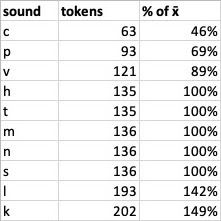
On the other end of things, /k/ and /l/ are significantly overrepresented at nearly 150% of average! ...Which also kind of makes sense because they're also favorites of mine.
I guess it just hadn't occurred to me that my own personal aesthetics would have figured so prominently in root choice with respect to phoneme frequency! I must have expected that each consonant would appear approximately equally, as odd as that would have been cross-linguistically?
That raises a really interesting point, though, which I also had never considered: the particular character of Koa as it has always existed manifests these frequency biases. Like any language, the phonemes are represented unequally, and that gives it an important part of its unique phonological character. As such, moving towards greater uniformity -- as my random picker would automatically tend to do -- would, over time, actually alter the feel of Koa.
And if I like the phonological aesthetics as they've been up to this point -- which it turns out I do -- I may actually not want to continue generating words this way! I'm not sure yet exactly how I'll do this, but what we really want is for the randomness to be weighted -- towards words with Koa's favorite phonemes, and away from words with those it prefers less -- such that a random sample of suggested words would tend to show the same frequency distribution as the language as a whole.
I almost wonder if I should go back to an earlier version of the file, run these numbers again, and use those statistics; the program potentially had a noticeable impact on the frequencies with those 200+ words in the past couple months. Though...on the other hand I was still vetting the choices so my aesthetics were still probably in force, even if being nudged. I could figure out the statistics of the recent additions on their own just to be sure.
Anyway this is certainly an interesting little surprise for me to ponder.
Sunday, January 29, 2023
Etymology statistics
Just a point of interest as I continue to organize my lexicon...
Of the 790 predicate roots assigned so far:
* 163 (21%) are derived from Finnish
* 57 (7%) are derived from Hawai'ian, Sāmoan, Tongan or Māori
* 75 (9%) are derived from other languages (Arabic, Basque, Bislama, Chinese, Doraja, Esperanto, French, Greek, Icelandic, Irish, Japanese, Latin, Lapine, Latvian, Malay, Nahuatl, Polish, Proto-World [ha ha], Quechua, Quenya, Russian, Seadi, Spanish, Swahili, Tagalog, Turkish, Swahili, or broad international usage)
* 34 (4%) are internally-derived
This means 295 (37%) of the current Koa root stock was derived in some way from other languages, compared with 495 (63%) that was either randomly generated, internally derived, or selected/created in some way (unfortunately there's no good way to distinguish randomness from intention reliably at this point). I find these figures a little surprising: it was my impression that the significant majority of Koa words was based in something -- to the point that I was stymied for a long time in creating more vocabulary when I couldn't find enough existing linguistic inspiration. Also, again, let's just pause for a second to acknowledge that Finnish has provided a fifth of Koa vocabulary.
Worthy of special mention are 6 roots (1%) that were created by friends or family members -- I'd love to swell that number moving forward!
Friday, January 27, 2023
A first Koa publication
In response to my children's repeated requests, I decided late last year that I would do my best to assemble a printed, kid-oriented, concise Koa dictionary in time for the Solstice. As the project took shape it grew beyond my original intention, eventually including a phrasebook and mini-grammar as well, and in the end I was pretty pleased with it as a snapshot in time of the development of this language.


It was also an opportunity to buckle down to some serious vocabulary creation, which had been languishing a bit in recent years; I'm pretty happy to finally have words like siki "particle," mohi "predicate," lelo "sentence," cóepo "alphabet" and címihale (or halecimi...more on that soon) "grammar."
In fact the process of creating needed vocabulary for the Úputusi Énasi sort of unblocked me and I've been on a bit of a rampage since then, coining around 200 new words over the past two months. What's been amazing is discovering that all that toiling in the syntactical, pragmatic and morphological mud I was doing in 2021 moved the structure of Koa to a place where now vocabulary is its primary need. Suddenly having all these words available, I'm finding that the language is much more speakable than I had previously expected, and with surprising expressive power.
As of today at noon, 774 of Koa's 3330 possible predicates have been defined. Emotional vocabulary has been my focus of late, but I'm starting to wonder what other thematic categories deserve some attention. Materials? Science? Botany? Civics? Geography? I've always been so intensely focus on word-worthiness and concerned about running out, but after 23 years I've still only used up a quarter of my possible roots!
Anyway, this was such a fun project that really jump-started some major progress after a pretty slow year. Unfortunately the dictionary doesn't seem to have inspired my girls toward total Koa fluency yet, but surely it's only a matter of time...
...And if you'd like to download the whole thing, a PDF is available here.
Sunday, January 22, 2023
Ni Ceso
This is a difficult moment in my life. It's not the first such moment that's passed since I started this blog, but it is the first time that I was actively working on Koa enough to have something to say. What this means, of course, is that I'm now going to make you read sad love poetry.
Seriously, though, this is the first native-Koa artistic composition since Aika Konuku in 2012, and the first non-translated work of poetry of any kind. It feels significant! It features Koa’s growing collection of emotive vocabulary, particularly "ceso" which means something like "incurious" but less highbrow: the opposite of "curious," desiring not to know, feeling pulled away from rather than towards understanding of something; it also makes heavy use of modal particles and clause nominalization.
As with the previous poem, I find myself really liking how compact, elegant and balanced Koa can be for poetry. I didn't expect this but it makes me happy! My shot at an English translation definitely loses some or all of that particular aesthetic sense of the Koa original.
Ni Ceso
Ni ceso
Noia na vi sano ni
Ka se cu nike he tana
Ka so cu ete mo kune
Ka ne se simo he ko meti pe to níkete
Ka ne se simo he ko meti pe to mehe
Ka ne se simo he ko meti pe ka kecu.
Ni ceso
Kelo se na te lu tai me ni
Kemo sisu ve se ca ma tala ko halu ni
Ka ma lolo se simo mo iule o ni
Ni na te koma ka natepakoma.
Ni na lu koma
Ni pavasu lo ko tala
Ni cu te hitui la hete to lise mo cali.
Ni na lu koma ka natepakoma
Ni na lu koma kelo se na te halu ni
Noia na vi sano ni
Ni ceso.
-Váhumaa, 2023-01-22
Translation:
I'm Not Curious
I'm not curious
Please don't tell me
Who you're seeing today
What you're doing together
What's in your heart when you think about that meeting
What's in your heart when you think about that person
What's in your heart when you think about the future.
I'm not curious
Why you can't want to be with me
How hard you're still trying to want me
What's holding your heart back from me
I can't understand the incomprehensible.
I don't want to understand
I'm worn out with trying
I could smash myself against that wall forever.
I don't want to understand the incomprehensible
I don't want to understand why you can't want me
Please don't tell me
I'm not curious.
-Portland, 1/22/23
Wednesday, January 4, 2023
Suso Ni
Voha usi iolo! I was just excited to rediscover another text, a sweet poem Olga and I wrote together in February of 2019. I've updated a few points of syntax and spelling conventions but the use of language was already pretty modern even four years ago. I had forgotten about this; I'm even a little bit surprised to be enjoying the simplicity of the poetic phrasing so much, the balance of structure, and the elegance of syntax that it turns out the particles make possible (suso ni mo iolo he koiolo).
Suso Ni
Suso ni noia
Suso ni ne lasa
Suso ni hepoa hepoa hepoa
Suso ni he súanose
Suso ni he súalase
Suso ni he ko páivalo
Suso ni he ko ívopime
Suso ni he ko nuku
Suso ni he ko vene
Suso ni noia
Suso ni ne lasa ne laki ne sase
Suso ni mo meli
Suso ni mo iolo he koiolo
Suso ni mo lime he kolime
Suso ni palóhani
Suso ni hepoa hepoa hepoa.
-le Óleka e le Iuli, Váhumaa, 2019-02-04
Translation:
Kiss Me
Kiss me please
Kiss me on my lips
Kiss me always always always
Kiss me at sunrise
Kiss me at sunset
Kiss me in the light of day
Kiss me in the dark of night
Kiss me asleep
Kiss me awake
Kiss me please
Kiss me on my lips, my cheeks, my forehead
Kiss me sweetly
Kiss me joyfully in times of happiness
Kiss me sadly in times of sorrow
Kiss me, my love
Kiss me always always always.
-Olga and Julie, Portland, 2/4/19
Monday, November 28, 2022
What's in a specifier?
There's no escaping it any longer: after decades of hemming and hawing, Koa's specifier system is just too damn complicated.
One might feasibly inquire what articles are doing in a putative IAL in the first place, and I've made a number of valiant attempts over the years (2010 and 2012, for example) to justify their existence by rigorously defining their use. Nonetheless, some inconvenient facts have been gently tapping on my shoulder recently, such as:
* Though theoretically beautifully defined, the system is so complex that the creator herself is often unsure of the best specifier choice in practice
* Specifier choice criteria seem to be much more detailed in pre-verbal (i.e. subject) position than post-verbally
* Following what you might call adjunct particles (ci he la lo me mo ne no o pe) there seems to be only a binary distinction -- definite vs indefinite -- which has never caused a problem
Indeed, going way, way back to basics, I have to confess that the most critical function of Koa specifiers is not in fact to elegantly plot fine distinctions on the axes of deixis, referentiality and discourse relevance, but probably just to help parse those predicates in the speech stream. As such, when preceded by one of those aforementioned adjunct particles, the primary work is already done and we can content ourselves with the pragmatic considerations that really matter: apparently only whether the NP in question is definite. Let's see, then, if we can reduce the system to a set of much simpler principles.
DEFINITE NPs are marked with ka when singular or optionally u when plural, unless:
* The NP requires being pointed at, whether physically or metaphorically, in order to be identifiable -- use ti/to "this/that"
* The NP is inalienably possessed by a pronominal referent -- use the relevant personal pronoun
* The NP is a name -- use le
INDEFINITE NPs are unmarked when preceded by another particle, or marked with a otherwise.
If you've been following the plot closely so far, you may have noticed that hu and po are conspicuously absent from the above taxonomy. I would in fact like to advance the theory that these have never been specifiers at all, but were mistaken as such because of their tendency to appear most frequently before unmarked NPs!
Let's start with the basic supposition that hu and po are in fact quantifiers, not specifiers: specifically ∃ and ∀, respectively. They can quantify indefinite NPs -- in which case there would be no article -- or definite ones, in which case they would be marked as described above. Examples of use, with both a logical and vernacular gloss:
po lulu i sihi
ALL flower VP plant
"for all flowers, it is the case that they are plants"
"(all) flowers are plants"
po ka lulu i puna
ALL DEF flower VP red
"for all of the flowers in a predefined set, it is the case that they are red"
"all the flowers are red"
hu lulu i puna
EXIST flower VP red
"for at least one flower, it is the case that it is red"
"a/some flowers exist such that they are red"
"some flowers are red," "there are red flowers"
hu ka lulu i puna
EXIST DEF flower VP red
"for one or more of a predefined set of flowers, it is the case that they are red"
"some of the flowers are red"
That seems clear and simple enough, but probably the thorniest area in the treatment of indefinite NPs has been in the choice between a and hu. For the last several years it's seemed that in practice the former is used for instantiated nouns -- real, specific things -- not yet raised to the discourse stage, whereas hu marked the NP as non-referential. Thus, heretofore:
1) ni mene la ko kou a tusi
1SG go DAT ABS buy INDEF book
"I went to buy a (certain) book"
2) ni mene la ko kou hu tusi
1SG go DAT ABS buy EXIST book
"for some book, it is the case that I went to buy it"
"I went to buy a (theoretical, not yet identified) book"
...but this is clearly far, far too fine a distinction to actually prescribe. Perhaps less elegant but more actually produceable by humans with competing resource demands beyond this single utterance:
1) ni mene la ko kou a tusi mao
1SG go DAT ABS buy INDEF book certain
"I went to buy a (certain) book"
2) ni mene la ko kou tusi
1SG go DAT ABS buy book
"I went to buy books, I went book-buying"
In fact ni mene la ko kou a tusi could potentially be interpreted in either sense according to context, and I think that's the important thing for me to accept here: that allowing context to play a role is not discarding all elegance or sophistication in this language.
Another place that things get confusing is around existential statements. What's the difference between these?
1) a lulu i ne ka masa
INDEF flower VP LOC DEF table
"a flower is on the table"
2) hu lulu i ne ka masa
EXIST flower VP LOC DEF table
"for at least one flower, it is the case that it is on the table"
"there's a flower on the table"
Semantically nothing at all, I think, but pragmatically these will have a different thrust. The purpose of (1) seems to be to communicate contextual information, whereas (2) is more concerned with the truth value of the proposition. If we really want to talk about existence and not truth value, I realized recently, we also have this option which is likewise vastly more human:
i me lulu ne ka masa
VP COM flower LOC DEF table
"there's a flower on the table"
or even
ka masa i me lulu (ne ta)
DEF table VP COM flower LOC 3SG
"the table's got a flower (on it)"
Hu is pretty straightforward for "some" in at least the quantifier sense of the English word, but note that there is a more periphrastic possibility as well:
hu lulu i puna
EXIST flower VP red
"some flowers are red" or "there are red flowers"
nai pi lulu i puna
some QUANT flower VP red
"some flowers are red"
So somehow or other that was actually pretty...easy? I'm almost a little nervous about it after all these years of fretting. I'll get back to you after I've tried it out in everyday usage.
Coming up next: if that's all clear now, maybe I can finally tackle how to say "something" and "nothing," a problem that has vexed me as long as I can remember -- this all came up right at this moment because I'm working on a bidirectional dictionary for my girls, and I couldn't figure out what to list as the generic translations!